
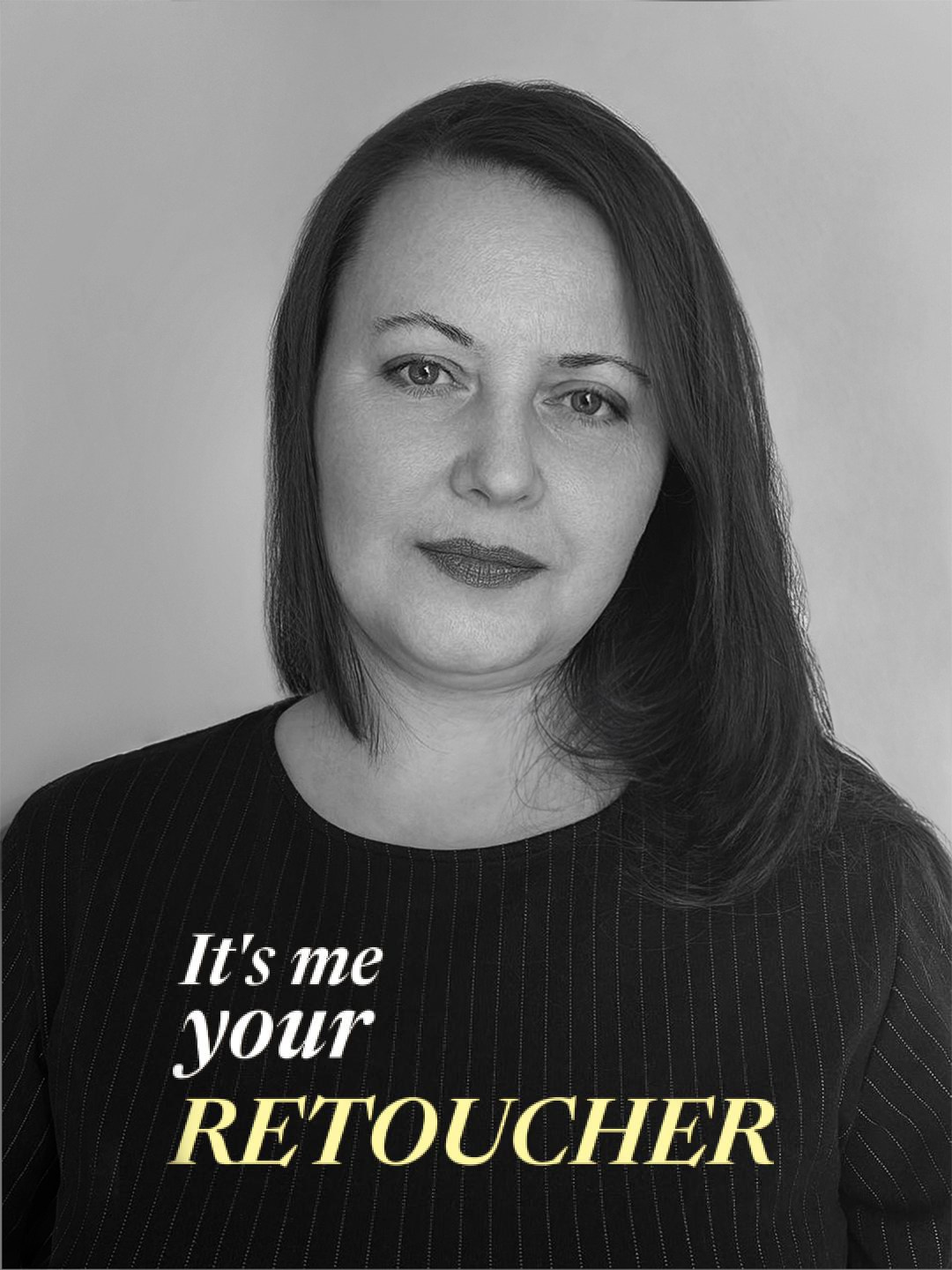
I’m Maria, a professional photo retoucher specializing in portrait, headshot, beauty, and commercial imagery.
I help photographers produce consistent, high-quality results while preserving natural skin texture and authentic expression.
Over years of dedicated work, I’ve developed a refined workflow based on Dodge & Burn and meticulous detail refinement, ensuring every image looks polished — but never over-processed.
How To Order
Sending your images for retouching is simple! Just email your original images (in RAW, TIFF, or JPG format) to buhajmaria@gmail.com along with your requirements and/or references.
You can use services like wetransfer.com or dropbox.com for sending large files.I’ll reply to you as soon as possible with the total price and estimated turnaround time.
The exact price depends on the original photo quality, your requirements, and the number of images.If the conditions are suitable for you, I’ll retouch one photo so you can see how my work enhances your shots.
Once you receive the first result, all you have to do is pay for your order and wait for the rest of the images to be retouched.
Payment Methods: Payoneer, BSB link, PaySend.Turnaround Time: Usually 1-3 days, depending on the quantity and requirements.
Let’s make your images look their best.
📩 Email: buhajmaria@gmail.com
High-End Retouching
First, let’s clarify what retouching actually is. Retouching is the modification of an original image in order to improve it. This includes removing skin imperfections (blemishes, wrinkles, under-eye shadows, redness, etc.), correcting body shape, hairstyle, and facial features. It may also involve background replacement, changing the color of certain elements (such as hair, eyes, or clothing), and overall color correction.Where is high-end retouching used? Primarily in advertising — in magazines and on billboards. Most often, these are studio fashion and beauty photographs, since skin imperfections are less noticeable in outdoor shots.So what is the difference between high-end and “regular” retouching? The difference lies in the techniques used and the time invested. High-end retouching often takes 2–3 hours per image and is done carefully and meticulously. As a result, the final image looks very realistic — as if it was captured that way straight out of the camera. In the past, when I looked at beautifully edited images without seeing the originals, I used to think: “Where did the photographer find such models with perfect skin?”Skin retouching that preserves natural texture is the most time-consuming part (especially in close-up studio beauty portraits). Correcting facial and body proportions is relatively easier, but it requires a strong sense of balance and taste to avoid overdoing it. Realistic background replacement can be challenging, particularly when dealing with flying hair and fine strands that must be carefully masked. Experienced retouchers handle this well, and some even redraw large portions of the hair to enhance volume and shine using a pen tool and graphic tablet. Think about shampoo and hair dye advertisements — a professional retoucher has carefully worked on every image.
Hair Retouching
This is one of the most labor-intensive types of retouching, and much depends on the hairstyle and its initial quality. A retoucher’s fee for a single image can equal a hairstylist’s fee for the entire shoot.During beauty shoots, phrases like “I’ll do my own hair/makeup” or “You can fix it later in Photoshop” should be forgotten. Such statements are typically made either by people who don’t understand the process or by those willing to overspend. On set, work should be done efficiently and professionally, not carelessly.
Cheap Retouching
Cheap retouching is immediately noticeable, even without seeing the original photo. It is done quickly and without attention to detail. The focus is on saving time rather than achieving quality.When it comes to skin editing, texture is not preserved but simply blurred, resulting in a plastic or wax-like appearance. This is often done using filters and plugins that professional retouchers generally avoid. Such services are typically offered by beginners or amateurs. Unfortunately, many clients are satisfied with these results, even though they look unnatural and aesthetically poor.Prices vary depending on the region. Freelancers from lower-income countries can afford to charge less. Often (though not always), a lower price reflects a lower level of skill and quality. However, experienced retouchers can command higher rates regardless of where they live.Let’s talk numbers. The lowest prices are often found in India and Bangladesh — around $1–5 per image, with correspondingly low quality. In Eastern Europe and Russia, rates typically range from $10 to $30 per image. In Western Europe and the United States, prices start at $50 and can reach $100 or even several hundred dollars. The highest rates usually apply to advertising work, where pricing depends largely on commercial usage and complexity. The most time-consuming and expensive types of work are beauty retouching, hair editing, and compositing.
Photographer ≠ Retoucher
Retouching is a separate profession. Post-production is not inherently a photographer’s responsibility. A photographer and a retoucher are related much like a makeup artist and a hairstylist, or a singer and a composer. Yes, there are multi-talented professionals, but they are rare.Personally, I support specialization — everyone should focus on their craft. If a photographer has enough time, they can learn retouching, but mastering it requires months and years of practice. And, of course, this work should be paid for separately, regardless of who performs it.Too often, photographers worsen already weak images with poor processing, prioritizing quantity over quality and targeting inexperienced clients in the lower price segment.
What to Consider
Unfortunately, the term “high-end” has been overused and devalued over the past decade. Even beginners who have just downloaded Photoshop may label their work as high-end. That does not make it so. Therefore, always evaluate a portfolio and pricing carefully.High-quality close-up portrait retouching is unlikely to cost less than $10 per image. If the price is significantly lower, it is reasonable to question the level of quality.If a photographer offers a $100 photoshoot including 30–50 “retouched” images, the expected level of detail becomes clear. Often, the word “retouched” is replaced with the more abstract term “edited, ” which may simply mean basic color correction or preset-based batch processing.
Final Thoughts
Achieving a great result requires teamwork. Mistakes in lighting, makeup, styling, or set preparation should be corrected during the shoot. Fixing them in post-production takes much more time — and therefore increases costs.Ideally, Photoshop should only be used to fix what cannot realistically be corrected during the shoot — such as certain skin imperfections.If the original images are of poor quality, even a highly skilled retoucher may not be able to achieve a strong result without significant time and expense.Remember: to achieve the best outcome, you need high-quality originals straight from the camera. Saving money on the photographer, makeup artist, or hairstylist while relying solely on retouching is not a wise strategy. At the same time, retouching should not be undervalued — balance is key. If you underpay one member of the team, you will inevitably overpay another.I completely agree with the author of these thoughts, Ivan Zayets.